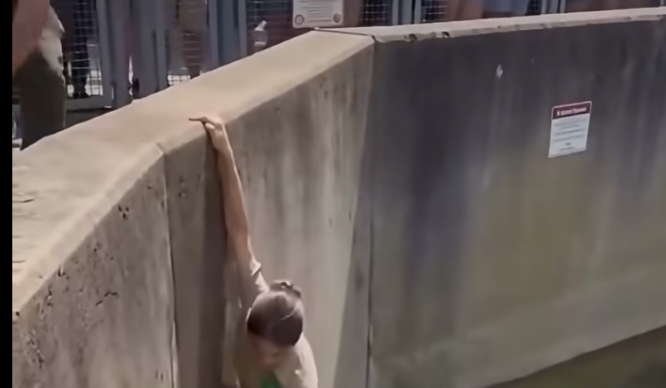
Fictional Story.
Before visitors entered the zoo, Hannah had already been working for hours.
She loved the quiet of the early morning: the gentle rattling of carts along the paths, the distant songs of birds, and the rustling of leaves before the crowds arrived. For nearly seven years, she had cared for the animals with a level of attention that most people never got to see.
An untouched food container. An unusual posture. A small change in behavior.
Those details mattered.
There was one enclosure that always reminded her never to let her guard down: the crocodile habitat.
The animal living there, Atlas, could remain motionless for so long that visitors sometimes mistook him for part of the landscape. Hannah had a deep respect for him, but she never forgot that he was a wild animal.
That morning began as usual.
A delivery arrived late, and a colleague was completing paperwork nearby. Hannah was preparing to carry out a routine task from the protected service area.
Then, something went wrong.
A piece of food fell just beyond where it was supposed to land.
For a brief moment, Hannah thought she could correct the mistake herself.
She moved too quickly.
The peaceful morning suddenly changed.
Hannah called out to her colleague, who responded immediately. Emergency protocols were activated. Staff cleared the area, contacted the specialized response team, and focused on getting Hannah to safety, away from the enclosure.
No visitors witnessed what had happened.
At the hospital, Hannah kept repeating the same sentence:
“I should have stopped.”
Her colleague, Mark, sat nearby.
“You stopped long enough to ask for help,” he said. “That mattered.”
Hannah recovered physically, but returning to work was difficult.
She missed the animals, the routine, and her colleagues. At the same time, she feared that people would remember her only for one moment of poor judgment.
Several weeks later, the zoo’s safety manager invited her to review the incident.
Hannah arrived with several pages of notes.
The review did not focus solely on her decision. It also identified changes the zoo could implement: clearer procedures for unexpected situations, updated equipment, and stronger reminders that no task is too insignificant to pause and reassess.
“You are responsible for your decision,” the manager told her. “But we are responsible for learning from it together.”
Those words stayed with Hannah.
As she continued recovering, she began helping update the training program for new animal caregivers. She encouraged staff to speak openly about near misses, uncertainty, and the temptation to rush through familiar routines.
“Experience doesn’t mean nothing can go wrong,” she told a group. “It means learning to recognize when it’s time to stop.”
Her first visit back to the zoo was brief. She entered through the staff entrance, caught up with friends, and sat near the gardens.
Later, she stood beside the safety manager, at a safe distance from the crocodile habitat.
Atlas rested near the water, silent and alert.
Hannah felt nervous, but she felt no anger. The animal had not broken any promises; he had behaved as a wild animal does.
The responsibility had always rested with the people caring for him.
Months later, Hannah led a training session for new staff members. After the session ended, a young caregiver stayed behind to ask a question about a procedure.
Hannah did not rush.
She set down her papers, listened carefully, and walked him through every step.
Because the most important lesson she had learned was simple:
When something doesn’t go according to plan, stopping to ask for help may be the strongest decision a person can make.